 ×

Photobiomodulation (PBM), often referred to in the professional wellness market as Photon Therapy, is a well-established area of research in non-invasive light-based wellness technology. At Liaoning Dikangyuan Health Technology, we have more than 15 years of experience developing and integrating light-based technologies with crystal heating systems.
PBM is a form of light therapy that utilizes non-ionizing light sources, including lasers, LEDs, and broadband light, typically within the visible and near-infrared spectrum. It is a non-thermal process in which specific wavelengths of light interact with biological chromophores and may influence biological processes at the cellular level. In simple terms, photon therapy uses precisely controlled light energy to interact with biological processes and has been widely studied in wellness and photobiomodulation applications.
To understand the scientific interest in photon therapy, it is useful to look at the mitochondria, the organelles responsible for energy production in human cells. Within the mitochondria, cytochrome c oxidase is one of the key chromophores studied in photobiomodulation research. Research suggests that light absorption by cytochrome c oxidase may influence nitric oxide interactions and mitochondrial activity.
When photons within commonly studied PBM wavelength ranges reach biological tissues, they may interact with cellular chromophores and influence mitochondrial processes. These cellular responses have been studied in relation to mitochondrial activity, cellular energy production, oxidative stress, and other biological signaling pathways.
Deep Spectrum Analysis: Wavelength Precision and Biological Efficacy
Dikangyuan’s professional wellness systems utilize a multi-wavelength approach, allowing different light sources to be incorporated according to the intended product design and application.
Blue Light — approximately 460–465nm
Blue light is a visible wavelength commonly used in light-based wellness and skincare applications. Its relatively shallow penetration makes it suitable for applications focused on the surface of the skin. In our photon systems, blue light can be integrated as part of a multi-wavelength light configuration.
Red Light — approximately 650–660nm
Red light is one of the most widely studied wavelength ranges in photobiomodulation research. Compared with blue light, red light can penetrate further into tissue and has been investigated for its interaction with cellular processes and mitochondrial activity. Our systems can incorporate red light around 660nm according to the product configuration.
Green Light — approximately 520–525nm
Green light can be incorporated into multi-wavelength photon systems to provide a broader spectrum of visible-light output. The wavelength can be selected according to the product design and intended wellness application.
Yellow Light (595–605 nm) is commonly included in multi-wavelength light systems and is often studied for its interaction with the skin and superficial tissues. In wellness applications, yellow light is generally associated with gentle light exposure and is commonly explored in relation to skin appearance, comfort, and overall radiance. Its relatively soft wavelength makes it a useful option for multi-wavelength photon systems designed for a broader range of wellness applications.
Blue-Violet Light (410–420 nm) provides a shorter wavelength within the visible light spectrum and is commonly studied for its interaction with the skin. It has been explored in research involving skin appearance and surface-level light applications. In multi-wavelength systems, blue-violet light can be incorporated as part of a broader spectral approach, complementing red, green, yellow, and near-infrared wavelengths.
Near-Infrared Light — approximately 850nm
Near-infrared (NIR) light generally penetrates deeper into tissue than visible red light and has been widely studied in photobiomodulation research. In wellness applications, NIR is commonly explored as part of multi-wavelength light systems.
By combining different wavelengths, manufacturers can create photon systems with different light configurations according to the intended application, product structure, and user experience.
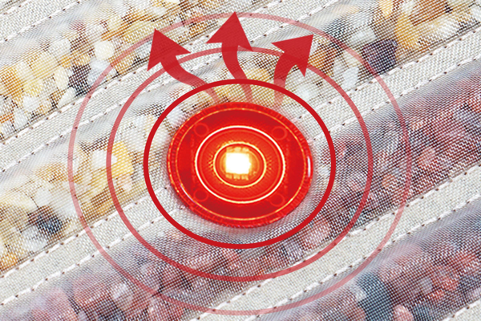
In a professional environment, the consistency and stability of the light source are important factors in product performance. Dikangyuan uses LED components designed for stable wavelength and output performance, with light intensity measured according to technical specifications such as mW/cm².
Our manufacturing process follows the ISO 13485 medical device quality management system, supporting structured quality control, traceability, and manufacturing consistency. Relevant photon products can also undergo technical inspection and testing to verify wavelength and output specifications.
For distributors and professional wellness partners, this technical consistency provides a reliable foundation for product development and market positioning. Depending on the product configuration, photon sessions can be incorporated into structured wellness routines according to the recommended operating instructions.
The future of photobiomodulation continues to develop as researchers investigate how different wavelengths, light doses, and delivery methods interact with biological systems. At Dikangyuan, we continue to explore light-based wellness technology and its integration with crystal heating, far-infrared, and other functional wellness technologies.
Our R&D team continues to follow developments in PBM research, including studies related to mitochondrial activity and cellular signaling. As the global wellness market increasingly focuses on non-pharmacological and technology-based wellness solutions, Dikangyuan remains committed to developing reliable light-based wellness systems for international partners.
We provide our partners with technical documentation, product information, marketing materials, and OEM/ODM support to help them introduce photon wellness products to their local markets.
 Hot News
2026-05-15
2026-05-12
2026-05-05
2026-04-28


 EN